I'd only recommend the Rancilio Silvia if you're willing to either add a PID or learn a temperature surfing routine for both espresso and milk. If that sounds like too much work, get the Breville Bambino and spend the savings on a good grinder.
The Silvia is one of the most durable espresso machines you can buy for around $1,000, but also one of the trickiest to use, because it has no temperature control beyond a basic thermostat. In this review I look at whether its espresso and steaming are worth that effort, and how it compares with its rivals.
I focus on the Silvia V6 (sold as the Silvia M in some markets), the current base model.
Should You Buy the Rancilio Silvia?
Only if you'll put in the work, or add a PID. Get its temperature under control and it can make some of the best espresso of any machine at its price.
Rancilio Silvia
Excellent espresso and commercial-grade steaming, but it takes practice to master.
Pros
- Incredibly durable. Many machines last decades.
- A higher espresso ceiling than similarly priced Breville and De'Longhi machines.
- An active modding community with plenty of tutorials and support.
Cons
- Needs temperature surfing for both espresso and steaming.
- You can't see the water level, so it is easy to run dry mid-shot.
If you want good espresso straight out of the box, the Breville Bambino is the easier choice. Its PID handles temperature for you, and it costs well under half as much, leaving budget for a proper espresso grinder.
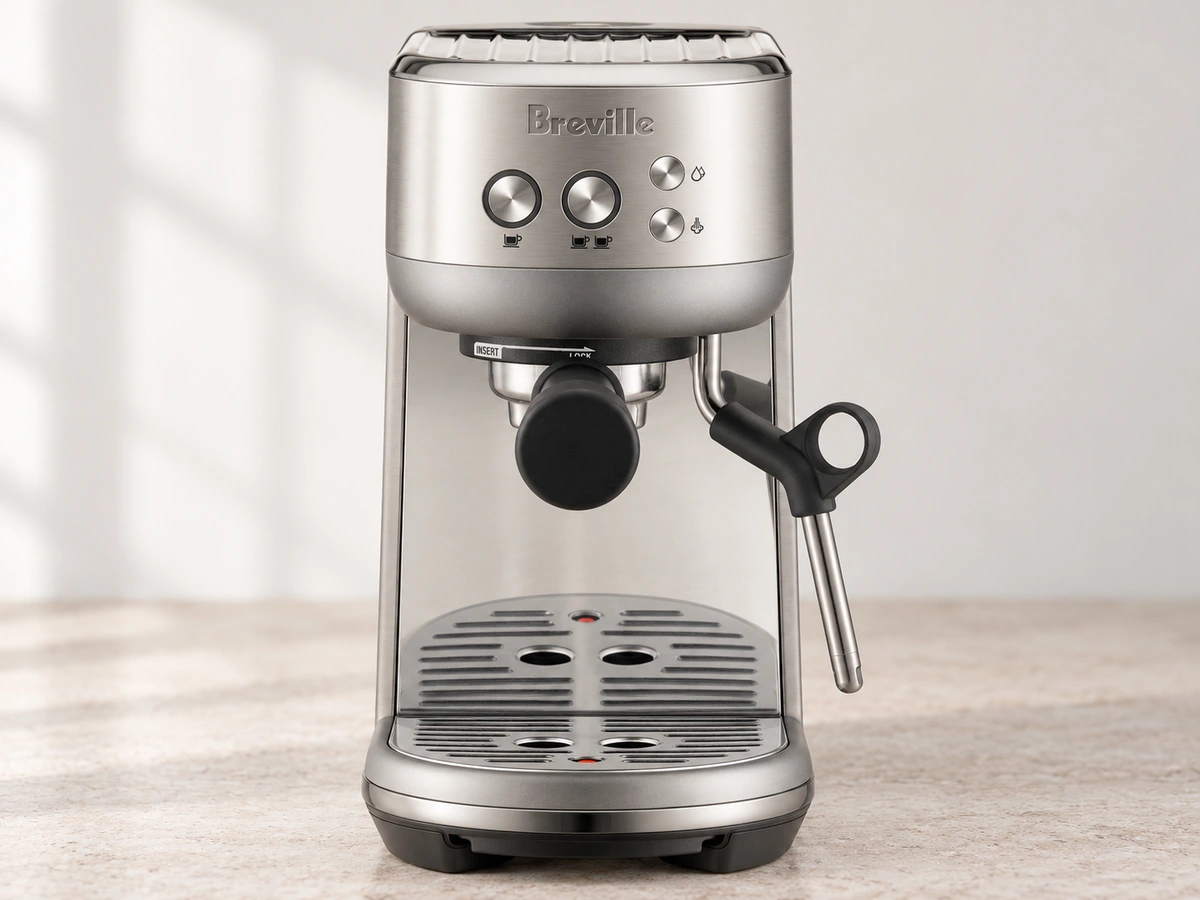
Breville Bambino
A built-in PID means no temperature surfing, and it heats up in seconds.
Machine Overview
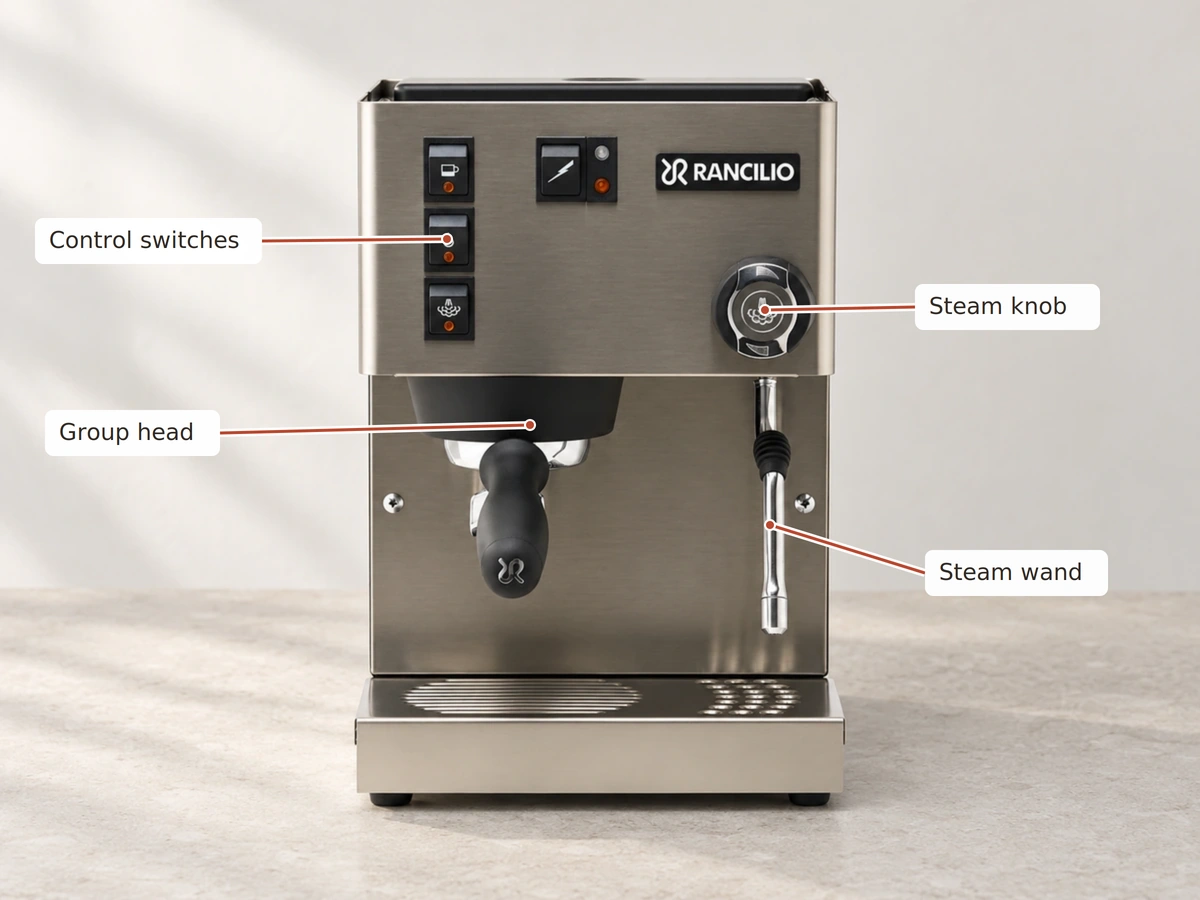
| Specification | Rancilio Silvia (V6) |
|---|---|
| Type | Semi-automatic |
| Controls | Four switches, two indicator lights |
| Heating | Single brass boiler (~300 ml / 10 oz) |
| PID | No (PID kits and PID-equipped versions available) |
| Heat-up (brewing) | ~5 minutes; ~15 minutes for the whole group |
| Brew to steam | ~60 to 90 seconds |
| Steam wand | Commercial-style, single hole |
| Portafilter | 58 mm with non-pressurized single and double baskets |
| Water tank | ~2 L (~67 oz), opaque |
| Cup clearance | ~4" |
| Dimensions (W x D x H) | 9.2" x 11.4" x 13.4" |
Build and Controls
Built like a tank, with simple but solid controls.
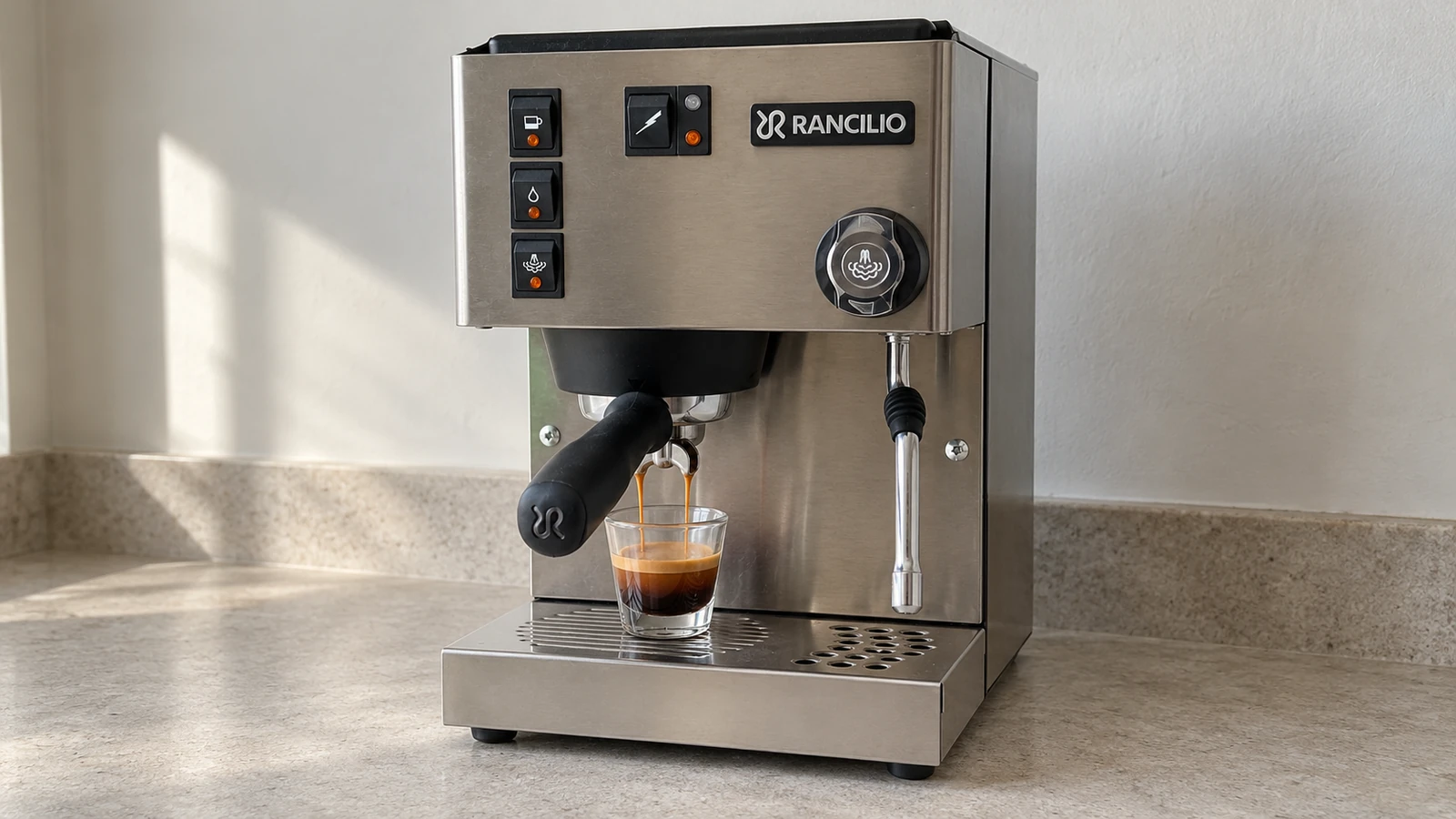
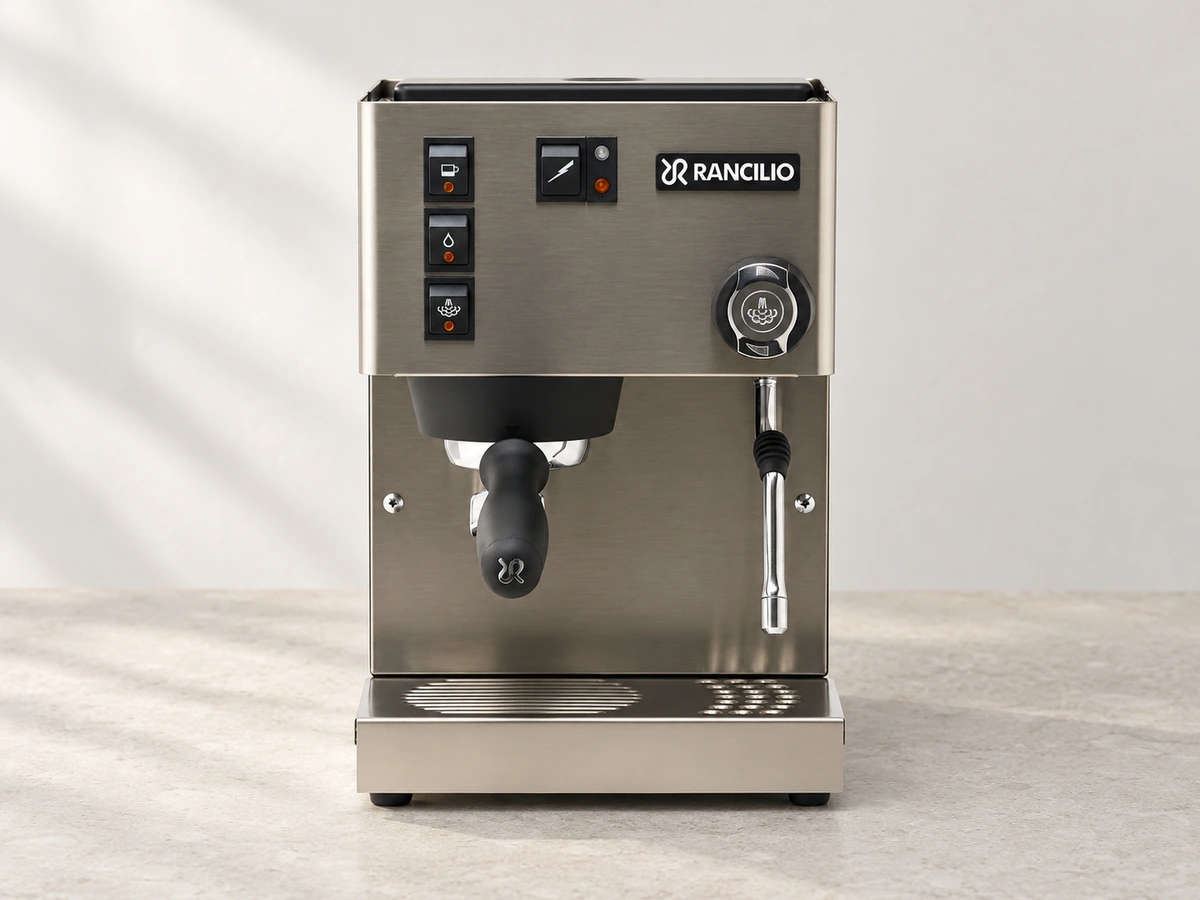
The Silvia is heavier and sturdier than most machines at its price. It is one of the few where you can lock in the portafilter without the machine sliding around.
You control it with four switches (power, brew, hot water and steam), each with its own small indicator light. Two more lights show power and heating. The heating light switches off when the boiler reaches temperature, a bit like an oven.
The body is almost entirely stainless steel. Only the steam knob, tank lid and switches are plastic. That is a big step up from similarly priced Breville and De'Longhi machines, which are mostly plastic.
Workflow
The Silvia has one of the most demanding workflows of any home espresso machine. The reason is temperature. Its thermostat lets the boiler swing over a fairly wide range, so the heating light is not a reliable "ready" signal. Managing this by hand is called temperature surfing.
Temperature Surfing for Espresso
If you brew as soon as the light goes off, as the manual suggests, the water is too hot and your shots taste harsh and burnt. A simple routine:
- 1Turn the machine on and let it heat fully (ideally 15 minutes or more, with the portafilter locked in).
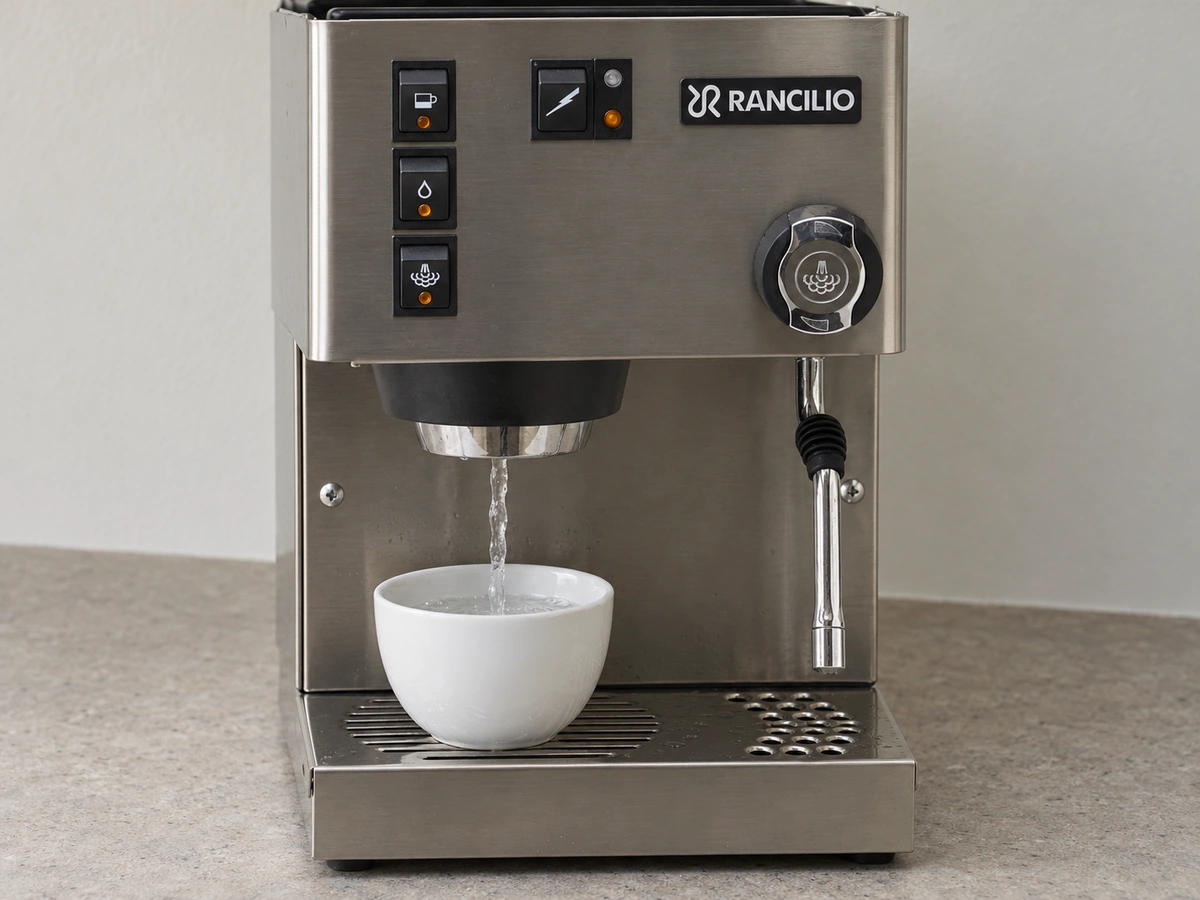
- 2Remove the portafilter and run water through the group until the heating light comes back on.
- 3Stop the flow and wait for the light to go off again.
- 4As soon as it goes off, lock in your loaded portafilter and brew.
Flushing pulls cold water into the boiler and brings the temperature down. The catch is that it uses a lot of water, and you can't easily see how much is left in the tank.
Temperature Surfing for Steaming
If you flip the steam switch and wait for the light to go off, the pressure is so high it can blow milk out of the jug. You can either:
- Purge steam for about 20 seconds into a spare jug before steaming, or
- Start steaming before the light goes off. This is faster and tidier, but takes practice. The right moment depends on how hot the boiler was when you flipped the switch.
Making a Milk Drink
You can steam first or brew first.
Steam first (the most popular method on r/ranciliosilvia):
- 1Prime the boiler first: press the hot water switch and open the steam valve until water flows steadily (about 10 to 15 seconds). Never heat the steam boiler without priming it, as that can damage the element.
- 2Steam your milk, starting a little before the heating light is due to go off.
- 3Turn off the steam switch, then flush both the group and the steam wand into cups to cool the boiler quickly.
- 4Pull your shot once you have completed the espresso surfing routine.
The downside: your milk cools a little while you pull the shot.
Brew first:
- 1Pull your shot using the espresso routine.
- 2Flip the steam switch and wait about 30 to 40 seconds (ignore the light).
- 3Start steaming.
The downside: your crema fades while you steam. Brewing a shot primes the boiler automatically, so you don't need the priming step.
Single Boiler Heating
The Silvia uses one ~300 ml boiler controlled by a thermostat, not a PID. It heats water to brewing temperature for espresso, and to a higher temperature for steam when you flip the steam switch.
Advantages:
- Durability. Boilers outlast ThermoJet and thermocoil systems. A Silvia can run for decades; a Breville at a similar price might give you five to ten years.
- Heat retention. The boiler sits right on top of the group, so the group, shower screen and locked-in portafilter all heat up. That keeps the brew temperature steady as water reaches the coffee. Give it about 15 minutes to warm through.
- Powerful steam. Close to a commercial machine. Too much power is easy to tame by purging; too little, as on the Gaggia Classic Pro or De'Longhi Dedica, cannot be fixed.
Disadvantages:
- Temperature surfing. Caused by the lack of a PID rather than the boiler itself, and fixable with a PID.
- No brewing and steaming at the same time. For that you need a dual boiler or heat exchanger machine, which generally costs much more.
Brewing Pressure
Out of the box, many Silvias brew at about 10 to 11 bar rather than the ideal 9. It is not a disaster, but higher pressure makes channeling slightly more likely.
You can lower it by adjusting the over-pressure valve (OPV). It means opening the top of the machine, but no electrical work. Here is a video showing how.
Water Tank
The ~2 L tank is a decent size, but you can't see how full it is. It is an opaque plastic tub with two hoses, one feeding the pump and one returning excess water from the OPV. Its compartment has no window or markings.
Because surfing uses so much water, you need to lift the lid and check the level before nearly every drink. Start with it less than a quarter full and you'll likely run out mid-drink, especially for a milk drink.
Drip Tray
The drip tray is poorly designed. A lip at the front means you have to lift the tray at an angle to pull it out, which sends the water sloshing backward. There is no float to warn you when it is full, so spills are common.
Portafilter
A weighty, commercial-standard 58 mm portafilter, so spare parts and accessories are easy to find. The back of the handle is angled so it sits flat on the counter without tipping, which is a lovely touch.
Accessories
The Silvia comes with a good metal tamper, single and double non-pressurized baskets, and a scoop. The tamper is a welcome change, as most machines at this price ship with useless plastic ones.
Note that the stock double basket holds about 16 g, not the usual 18 g. If you are coming from a Breville or Gaggia, adjust your recipe or buy an 18 g basket.
Modding
The Silvia is easy to mod and has an active community on Reddit, coffee forums and YouTube. The two most popular mods:
- Adding a PID. This involves wiring work, so if fixing a plug intimidates you, it may be a struggle. Kits from companies such as Auber are widely used. Here is a PID install video.
- Adjusting the OPV to 9 bar (see above).
Its main modding rival is the Gaggia Classic Pro. The Silvia has a slightly larger ecosystem, while the Gaggia is cheaper and simpler to open up, so it can feel less intimidating for a first-time modder. See Gaggia Classic Pro vs Rancilio Silvia.
Ratings
| Category | Score |
|---|---|
| Espresso quality | 9/10 |
| Milk steaming | 9/10 |
| Ease of use and cleaning | 4/10 |
| Design and build quality | 8/10 |
| Value | 8/10 |
Espresso Quality: 9/10
Excellent, especially if you let it heat up fully, but inconsistent without a PID.
The Silvia can make better espresso than similarly priced Breville and De'Longhi machines for two reasons:
- It handles very fine grinds well. A finer grind gives fuller extraction, so you get a richer, heavier-bodied shot.
- It heats the whole brew path. Brevilles heat water on demand, so some heat is lost through the group and portafilter. The Silvia's hot group and portafilter lose less.
The catch is consistency. Even a careful surfing routine involves guesswork, while a PID holds the same temperature every time. Adding one fixes the problem.
Milk Steaming: 9/10
Excellent once you learn it. Use it as the manual says and you'll spray milk everywhere. Learn when to open the valve and it steams far faster than Breville, De'Longhi or Gaggia machines at this price, giving dense, creamy microfoam.
The speed can be a challenge for beginners, since you have less time to texture the milk before it hits temperature.
Ease of Use and Cleaning: 4/10
One of the steepest learning curves of any espresso machine. You surf for both brewing and steaming, and the steam wand is powerful.
On the plus side, its three-way solenoid valve leaves you with dry, firm pucks. On the minus side, the drip tray means you will probably flood the base at least once (I did).
It needs descaling every few months, but it won't remind you and doesn't come with descaler.
Design and Build Quality: 8/10
Superb build, with a couple of annoying design quirks. Its simple design and quality materials make it a potential buy-it-for-life machine. It is a regular on r/BuyItForLife, and you often see decade-old machines selling in great condition.
The flaws:
- You can't see the water level.
- The drip tray is easy to spill.
Value: 8/10
Good value for the right person. If the Silvia came with a PID as standard, it would be outstanding value even at a higher price. As it is, it is good value if you are happy to surf or add a PID. Just know that easier machines cost much less.
Alternatives
Breville Bambino: Much Easier
Its PID means no temperature surfing, its gentler steam wand is easier for beginners, and it heats up in about 3 seconds. The trade-off is durability: expect five to ten years from a Bambino, against decades from a Silvia. If you want automatic milk frothing, the Bambino Plus adds it; see Bambino Plus vs Barista Express.
Gaggia Classic Pro: Better Value
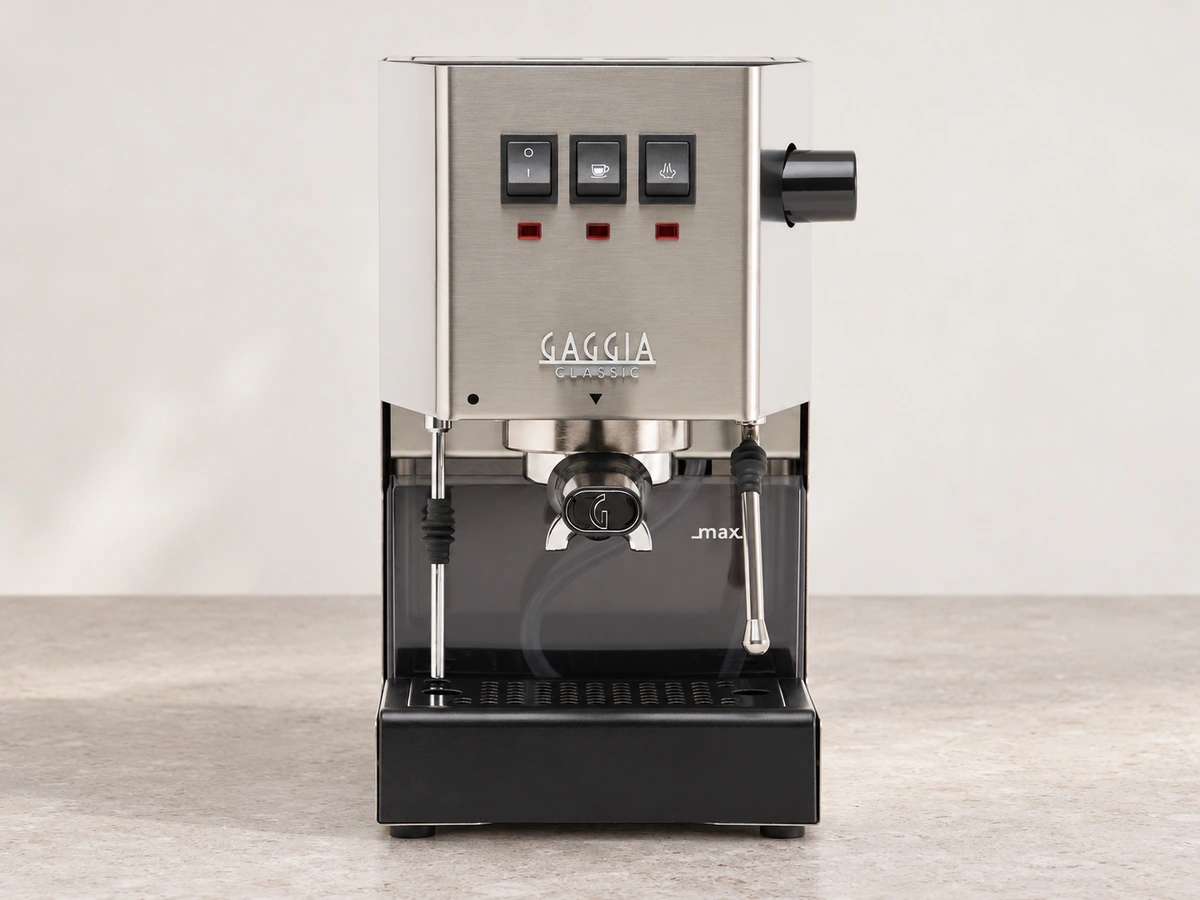
Gaggia Classic Pro
Similar espresso and build at a much lower price, with slower steaming.
Affiliate link — we may earn a commission at no cost to you.
The Gaggia costs several hundred dollars less and is similarly durable and moddable. Newer Classic Evo Pro models also ship with a 9-bar OPV, so no pressure mod is needed.
Its main weakness is steaming. Its much smaller boiler steams roughly half as fast, and you can't mod that away. If you mostly drink straight espresso, the Gaggia is clearly better value. If you make lots of milk drinks, the Silvia's steam power is its biggest advantage. Read my full Gaggia Classic Pro review.
My Recommendation
The Rancilio Silvia is an excellent home espresso machine if you'll develop a surfing routine or add a PID. If you won't do either, get the Breville Bambino and spend the difference on a good grinder.
Still comparing? See my best espresso machines under $1,000 and best espresso machines for beginners.
Common Questions
Is the Rancilio Silvia worth it?
Yes, if you'll temperature surf for every drink or fit a PID. If not, the Breville Bambino gives you easier, more consistent results for much less money.
What is the difference between the Rancilio Silvia V5 and V6?
The V6 has a more corrosion-resistant stainless steel heating element, a better-insulated boiler for steadier temperature, and a heat-insulated group head, so you're less likely to burn yourself.
How long does the Rancilio Silvia take to heat up?
About 5 minutes for the boiler (when the heating light first goes off), but about 15 minutes for the whole group and portafilter. Wait the full 15 for the best espresso.

Written by · reviewed by the Cicada Coffee Bar team
Daniel Voss
Lead Equipment Reviewer, Cicada Coffee Bar
Daniel leads the equipment-testing side of Cicada Coffee Bar. Every super-automatic, semi-automatic, and grinder featured on this site is bought or sourced independently, set up on the test bench, and brewed with daily for at least two weeks before a single word is written — tracking espresso quality, milk texture, ease of cleaning, and long-term reliability. Reviews are updated whenever pricing or firmware changes.