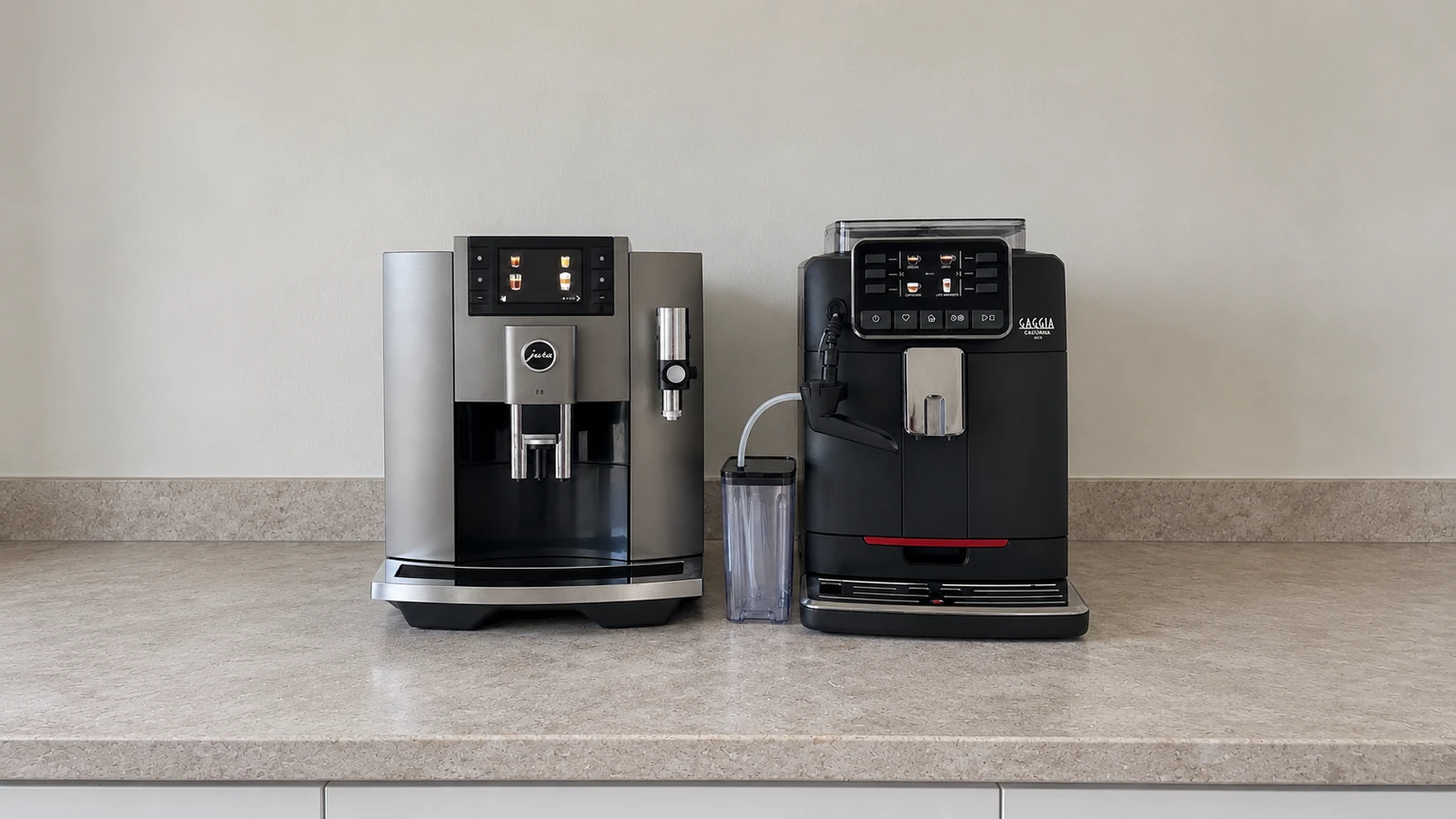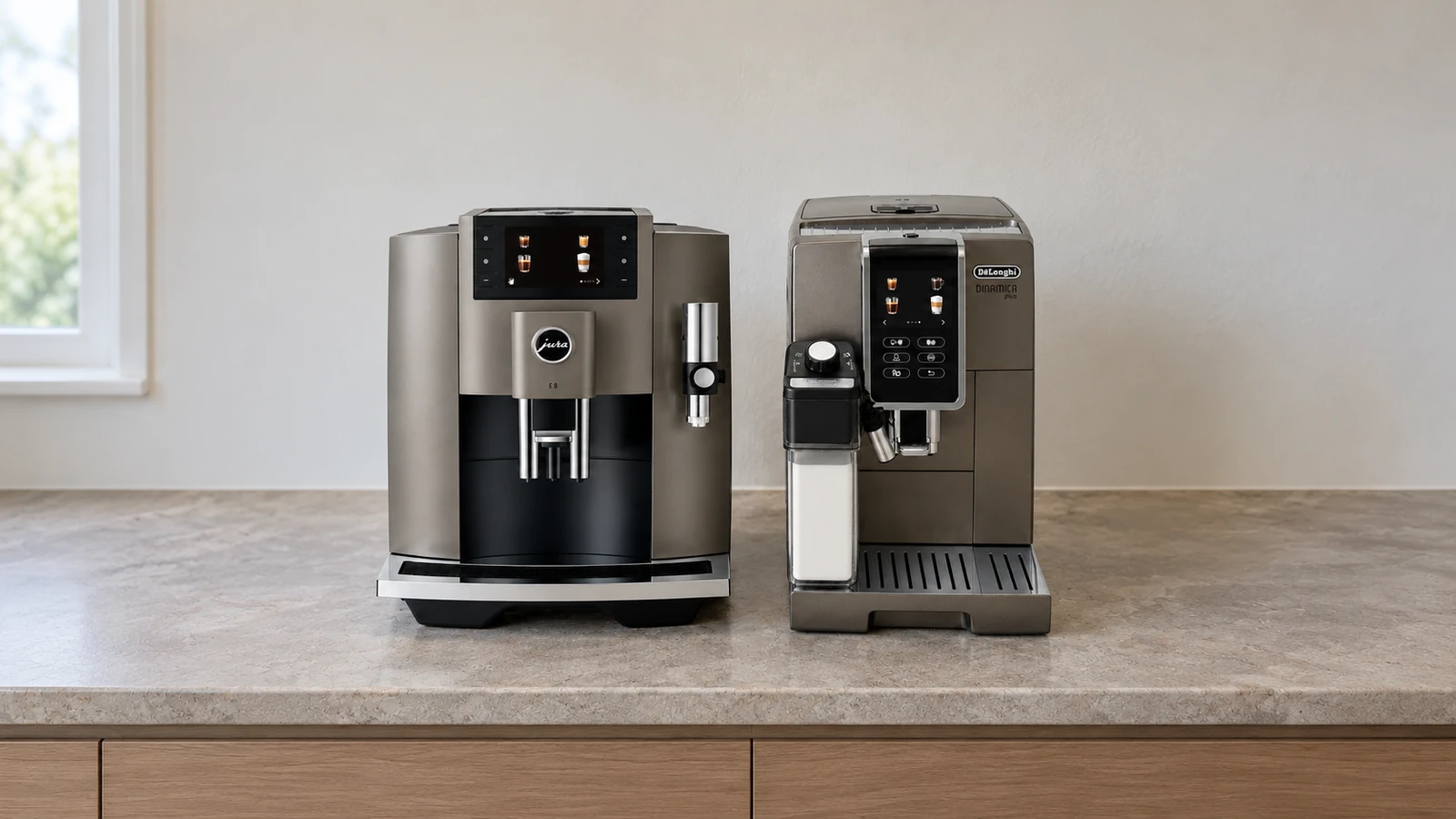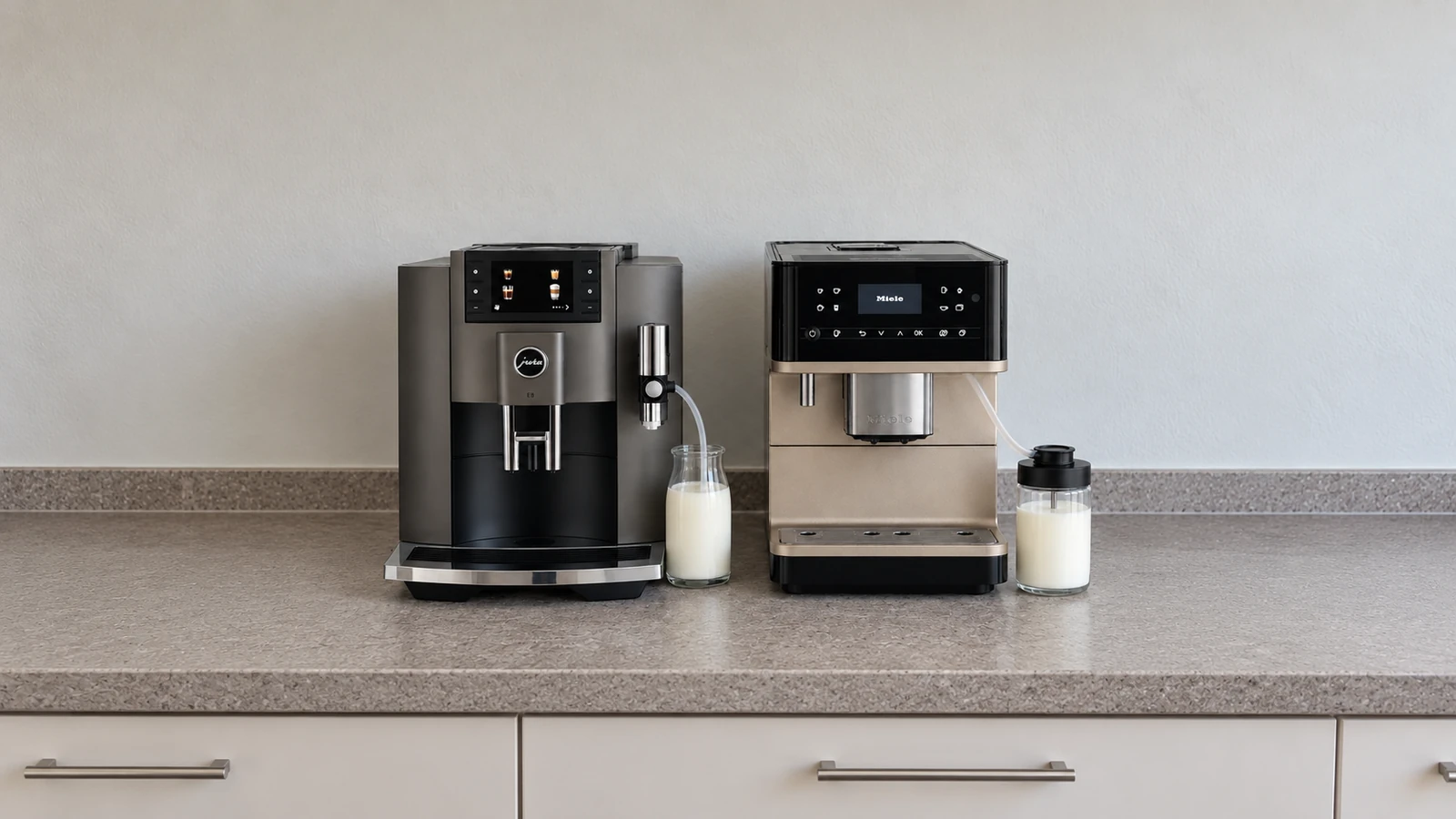
In short: I recommend Jura over Miele. Jura machines grind finer and make noticeably better espresso. A good place to start is the Jura E8, or the cheaper E6 if you want the best value.
Both brands make premium super-automatics that grind, brew and froth milk at the touch of a button. To keep things concrete, I compare two popular, similarly priced models, the Jura E8 and the Miele CM6360, and point out where the differences apply to each brand more generally.
Jura or Miele?
Jura, because the espresso is better. In my testing, the Miele's grinder couldn't grind fine enough for proper extraction, so its espresso tasted weak and watery next to the Jura's.
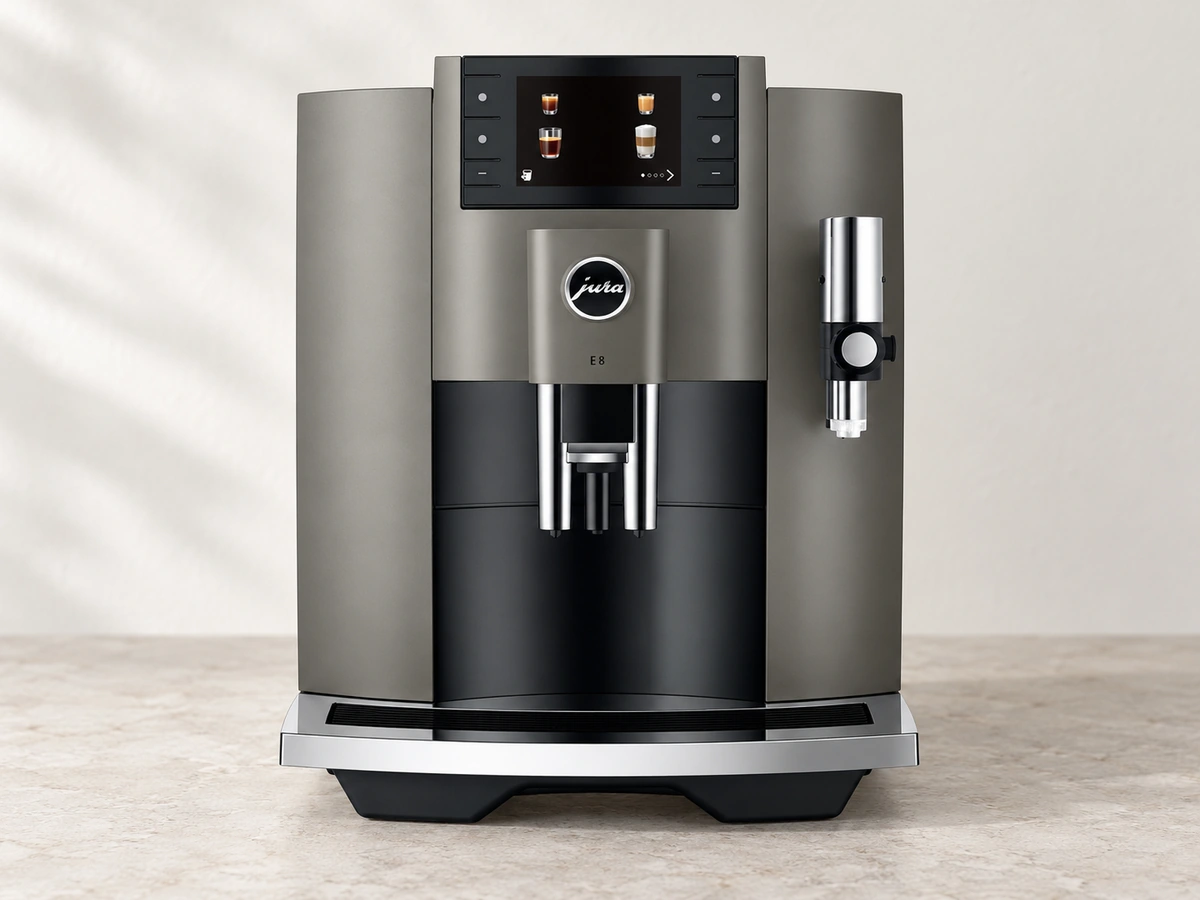
Jura E8
A finer grinder and a slower, pulsed brew make richer espresso than Miele.
Affiliate link — we may earn a commission at no cost to you.
For more, see my hands-on Jura E8 review. If you want to spend less, the Jura E6 makes the same quality espresso with fewer drinks; compare them in Jura E6 vs E8.
The Differences
In order of importance:
Grinder
The Jura grinds much finer. Both have only a handful of grind settings (six on the E8, five on the Miele), but the Jura's finest setting is much finer.
Espresso needs a fine grind so the water can reach as much of the coffee's surface as possible. In my experience, the Miele simply doesn't get there, which leaves its espresso dull. Miele uses much the same grinder across its range, so this applies to its other models too.
This is the biggest difference between the brands, and the main reason I can't recommend Miele over Jura.
Winner: Jura
Brewing System
Jura brews more slowly. Jura's Pulse Extraction Process (P.E.P.) pushes water through the coffee in short bursts rather than one continuous flow. Miele brews in one go.
It's hard to say how much of Jura's better taste comes from P.E.P. and how much from the finer grind. What I'm sure of is that the result tastes better.
Winner: Jura
Drink Customization
Both let you adjust strength, coffee volume and milk volume, but Jura makes it easier. On the Jura, you nudge strength and size up or down as part of making each drink, then save it as your default if you like.
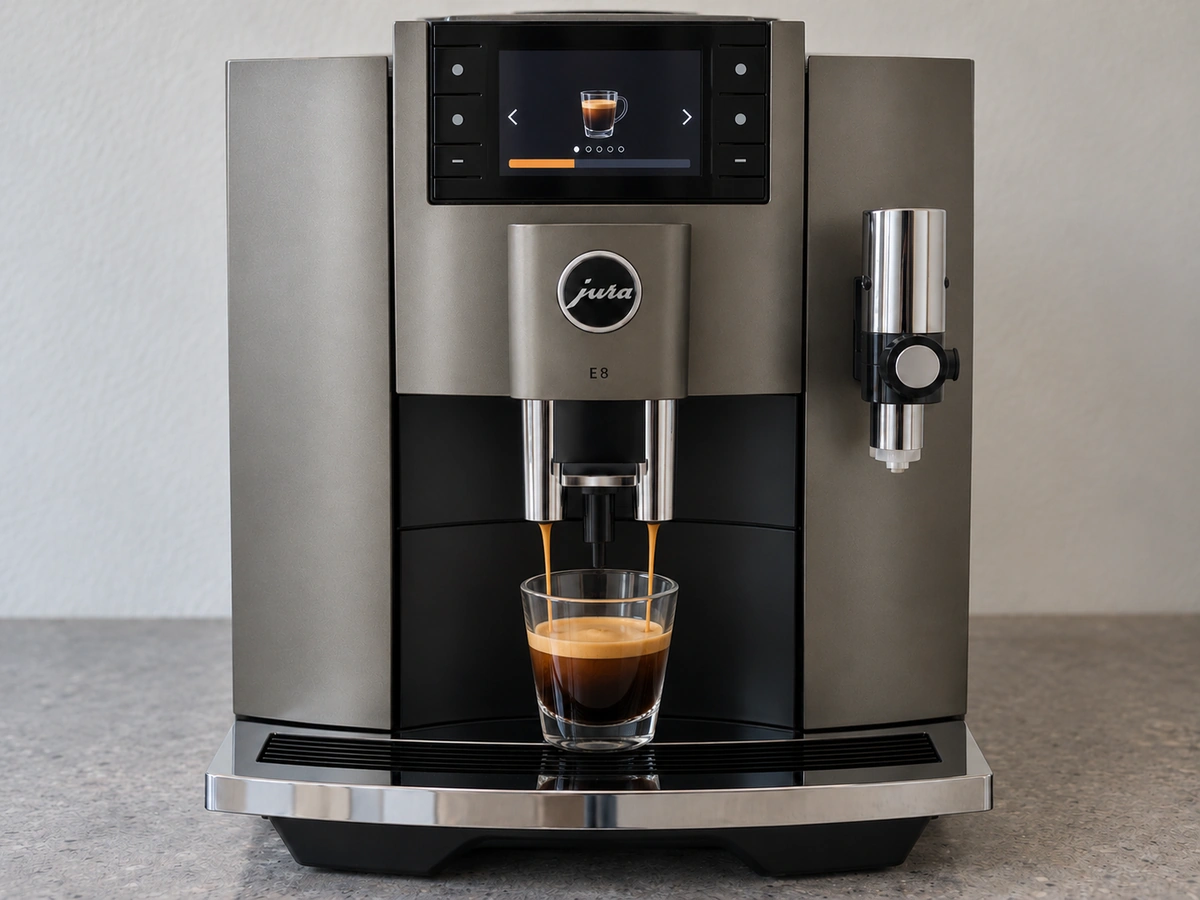
On the Miele, you enter a separate customize mode and stop the brew manually once the cup reaches the size you want. That gives fine control but is much more hassle. I prefer Jura's convenience.
Winner: Jura
Milk Container
Both use a similar system: milk is drawn up through a tube. The difference is that Miele includes a milk container that docks neatly, while the Jura E8 usually comes with just the tube, which you dip into your own jug or carton. Pulling that tube out tends to drip milk on the counter, and it looks a bit cheap. Jura sells milk containers and coolers separately.
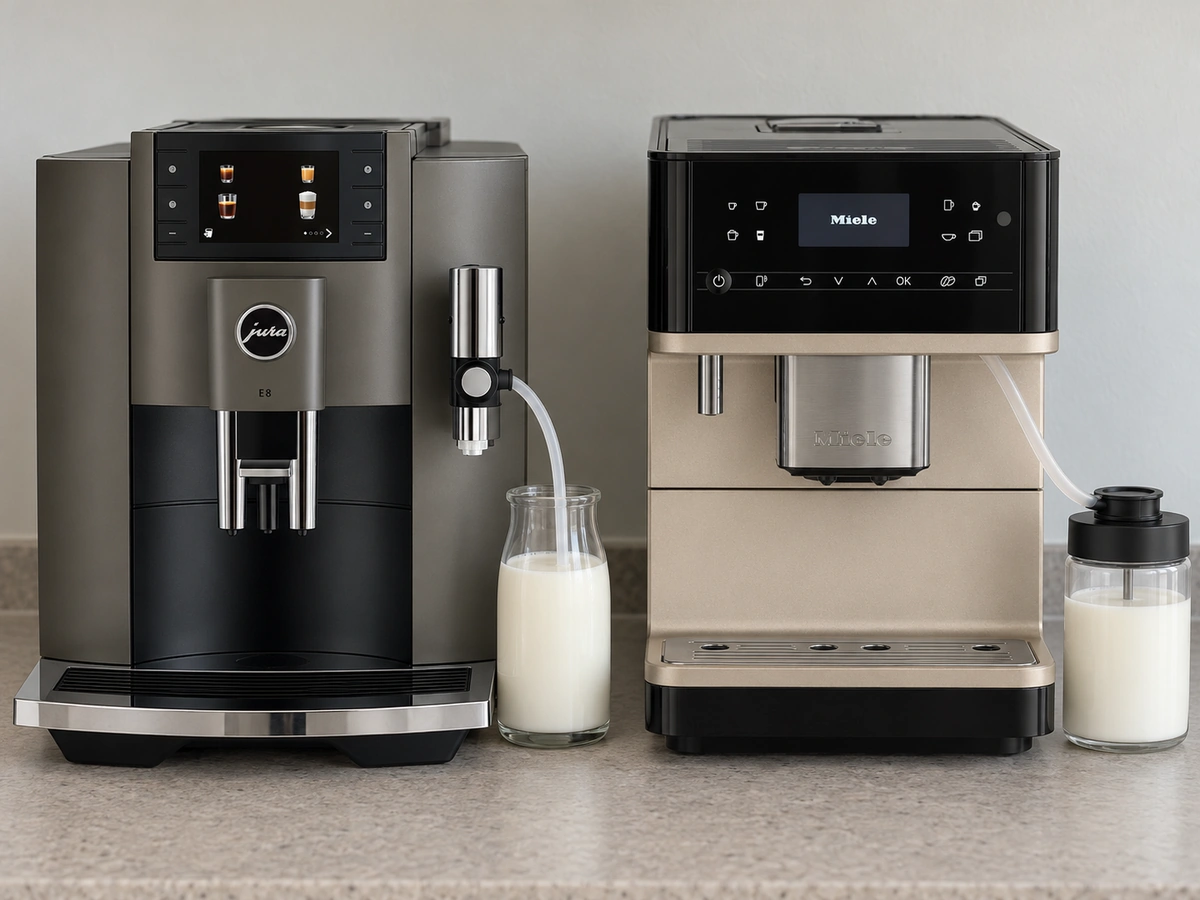
Winner: Miele
App
The Miele CM6360 works with Miele's app out of the box. The Jura E8 needs Jura's Smart Connect dongle, sold separately. I think it's a bit cheeky of Jura to charge extra; pricier models like the Jura Z10 include it. Jura's app works better, but Miele's being included wins.
Winner: Miele
Removable Brew Unit
You can remove the Miele's brew unit; you can't on a Jura. Many super-automatic problems are fixed by rinsing and lubricating the brew unit. With a Jura, the brew unit stays inside and is cleaned by tablets during the cleaning cycle. Any deeper maintenance means a service, so expect more trips to a technician over the years.
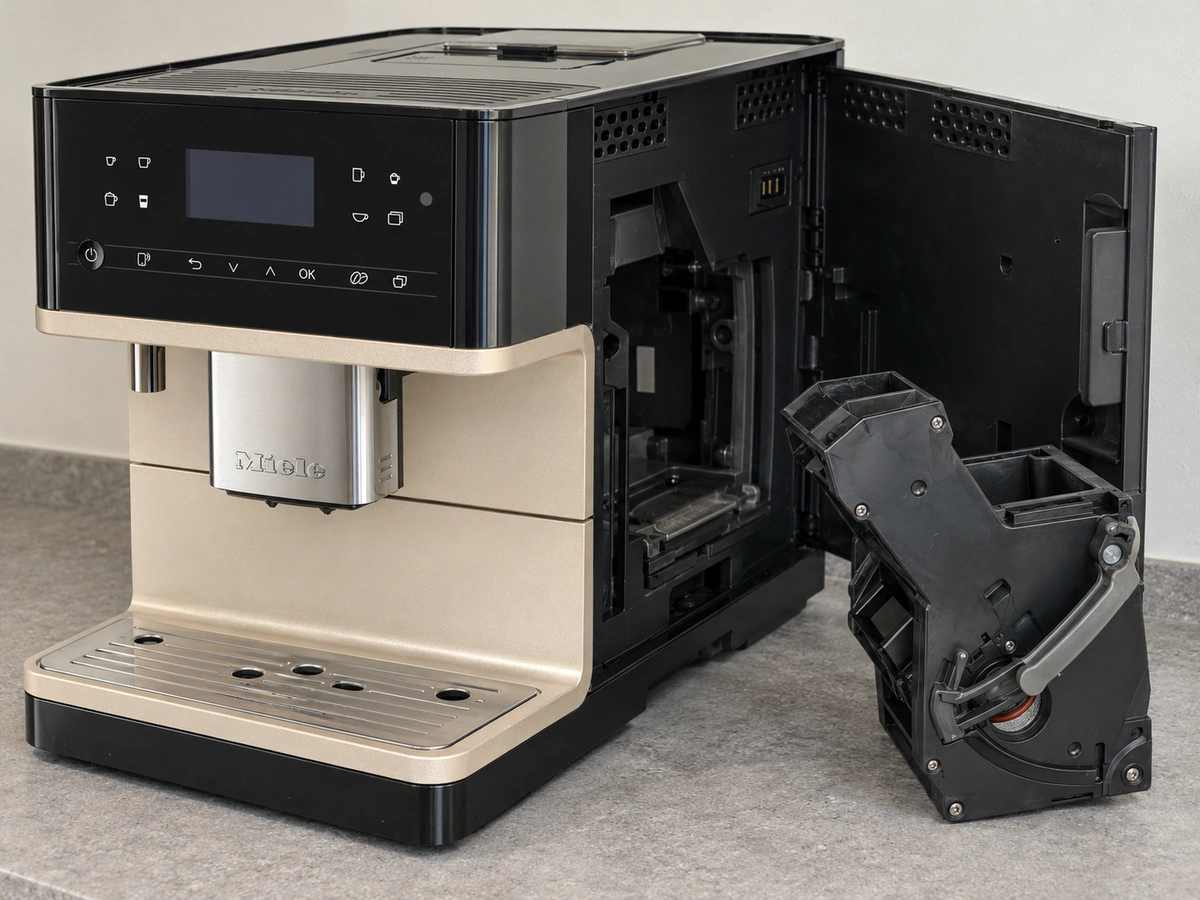
Winner: Miele
Descaling
With a CLARIS Smart filter, a Jura rarely needs descaling. It treats the water as it goes, so the descaling cycle is mainly needed if you don't use a filter. Miele machines need regular descaling, typically every few months depending on your water. It's one less chore with Jura, though you do pay for filters.
Winner: Jura
User Profiles
The Miele CM6360 lets several people save their own drink settings; the Jura E8 doesn't have user profiles. Even so, for an office I'd still choose a Jura because its espresso is so much better.
Winner: Miele
What They Have in Common
One-Touch Drinks
Both grind, dose, tamp and brew automatically and froth milk hands-free, so espresso, long coffee, latte or cappuccino are all one press away.
Similar Menus
| Jura E8 | Miele CM6360 |
|---|---|
| Espresso | Espresso |
| Ristretto | Ristretto |
| Espresso doppio | Coffee |
| Café crème | Long coffee |
| Lungo barista | Cappuccino |
| Café barista | Latte macchiato |
| Cappuccino | Espresso macchiato |
| Flat white | Cappuccino Italiano |
| Cortado | Flat white |
| Macchiato | Café au lait |
| Latte macchiato | Caffè latte |
Both can make double servings, and since milk and coffee volumes are adjustable, you can recreate almost any drink on either. A missing menu item isn't a reason to choose one over the other.
Controls
Both use buttons with a color display. The Miele has dedicated drink buttons, while the Jura shows drinks on screen. The workflow is almost identical, apart from Jura's easier customization.
| Jura E8 | Miele CM6360 | |
|---|---|---|
| Type | Super-automatic | Super-automatic |
| Milk system | Tube into your own container | Tube with included container |
| Black drinks | 6 | 4 |
| Milk drinks | 5 | 7 |
| Strength levels | 8 | 7 |
| Brew temperatures | 2 | 3 |
| User profiles | No | Yes |
| Grinder | Conical burr (6 settings) | Conical burr (5 settings) |
| Pre-ground bypass | Yes | Yes |
| Removable brew unit | No | Yes |
| Water filter | CLARIS Smart | Optional |
| App | Extra-cost dongle | Included |
| Dimensions (W x D x H) | 11" x 17.3" x 13.8" | 9.9" x 14.1" x 16.8" |
Espresso Quality
Jura, clearly. Its espresso has fuller flavor and better body, thanks to a finer grind and slower brewing. This is the biggest difference between the two brands.
Winner: Jura
Milk
Very similar foam from very similar systems. The Miele edges it because its included milk container is tidier than dipping a tube into a carton.
Winner: Miele, narrowly
Features and Settings
About the same. Similarly priced models have similar menus and customizations. Neither lets you change milk texture. For that, look at De'Longhi models like the Dinamica Plus.
Winner: tie
Ease of Use
Jura is easier day to day, for three reasons:
- On-the-fly adjustments. No separate customize mode.
- Fewer rinses. In my experience, the Miele ran frequent, slow rinse cycles, sometimes sitting on "rinsing" for a while before anything happened. The Jura rinses when you switch it on and off, or when you ask it to.
- Quieter. My Miele hummed on standby; the Jura didn't.
Miele's user profiles are handy, but they don't outweigh these.
Winner: Jura
Build Quality and Durability
Both are very well built and should last well beyond five years of daily use with proper care. Both are generally sturdier than entry-level Philips or Gaggia super-automatics.
Durability works differently for each brand, though. A Miele's removable brew unit makes home maintenance easier, while a Jura relies on cleaning tablets and periodic professional servicing.
Winner: tie
Value
Jura gives you better value because you get better espresso for similar money.
Winner: Jura
Other Options to Consider
De'Longhi Dinamica Plus: Better Value
The Dinamica Plus usually costs well under a Jura E8 or Miele CM6360, yet adds three milk textures, a touchscreen and a removable brew unit. For most people, it's the better-value super-automatic. Read my Dinamica Plus review.
De'Longhi Eletta Explore: Best for Iced Lattes
The Eletta Explore makes cold milk foam for iced lattes. The Jura Z10 can do this too, but costs much more for only small gains in coffee quality.
Which One I'd Choose
Choose Jura. Its espresso is clearly better than Miele's, and that's what matters most in a coffee machine. Miele wins on a few conveniences (included milk container, free app, removable brew unit, user profiles), but not on what ends up in the cup.
To choose a model, see my best Jura coffee machines. Also comparing other brands? See Jura vs De'Longhi, Breville vs Jura and Jura vs Gaggia.
Jura vs Miele FAQs
Is Jura better than Miele?
For espresso, yes. Jura grinds finer and brews more slowly, giving richer shots. Miele is better on a few conveniences, like its removable brew unit and included milk container.
Do Jura machines need descaling?
Rarely, if you use a CLARIS Smart filter and change it when prompted. Without a filter, you'll need to run the descaling program regularly.
Can you remove the brew unit on a Jura?
No. Jura brew units are cleaned automatically with cleaning tablets, and deeper maintenance is done by a service center.
Written by · reviewed by the Cicada Coffee Bar team
Daniel Voss
Lead Equipment Reviewer, Cicada Coffee Bar
Daniel leads the equipment-testing side of Cicada Coffee Bar. Every super-automatic, semi-automatic, and grinder featured on this site is bought or sourced independently, set up on the test bench, and brewed with daily for at least two weeks before a single word is written — tracking espresso quality, milk texture, ease of cleaning, and long-term reliability. Reviews are updated whenever pricing or firmware changes.