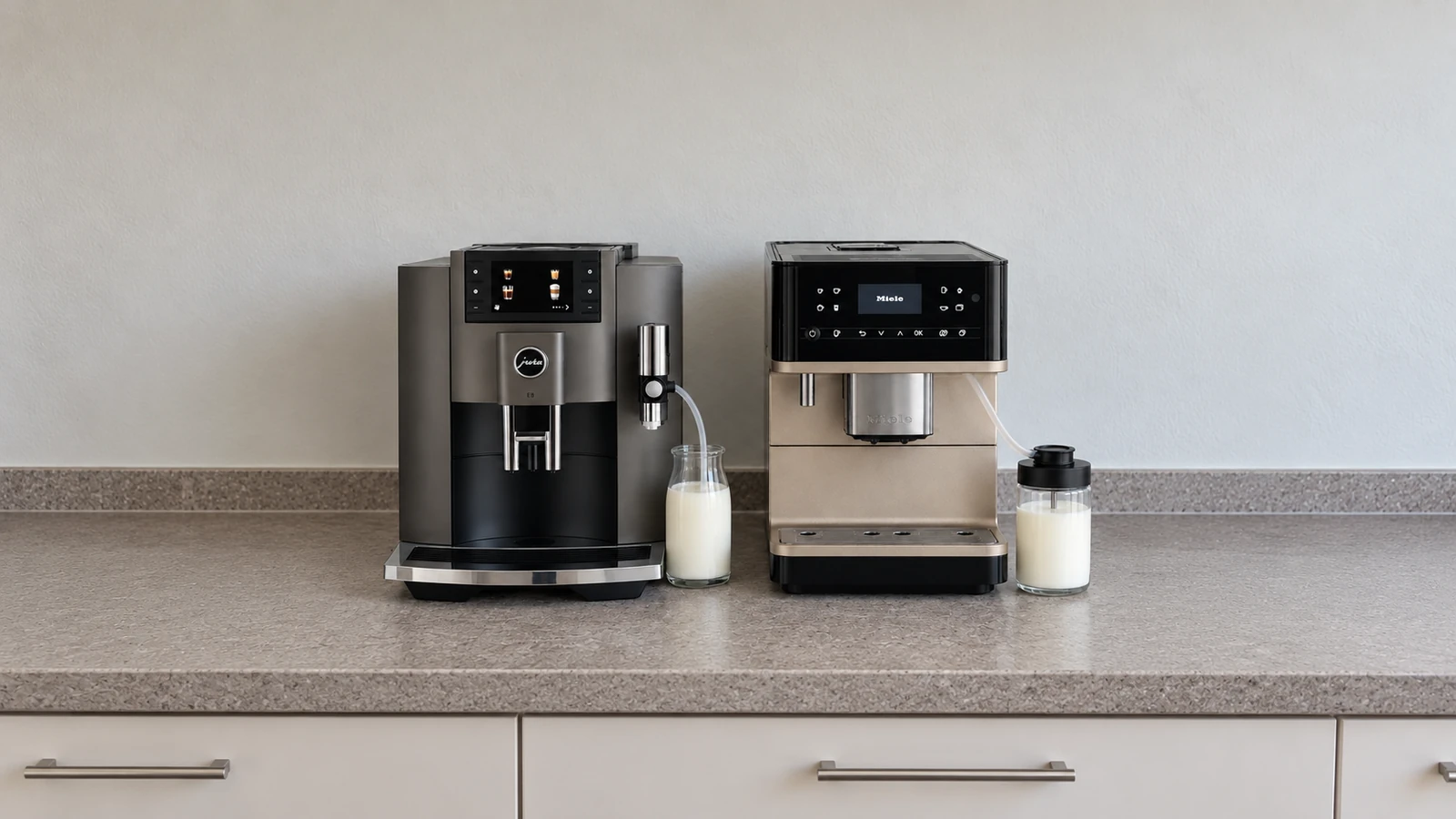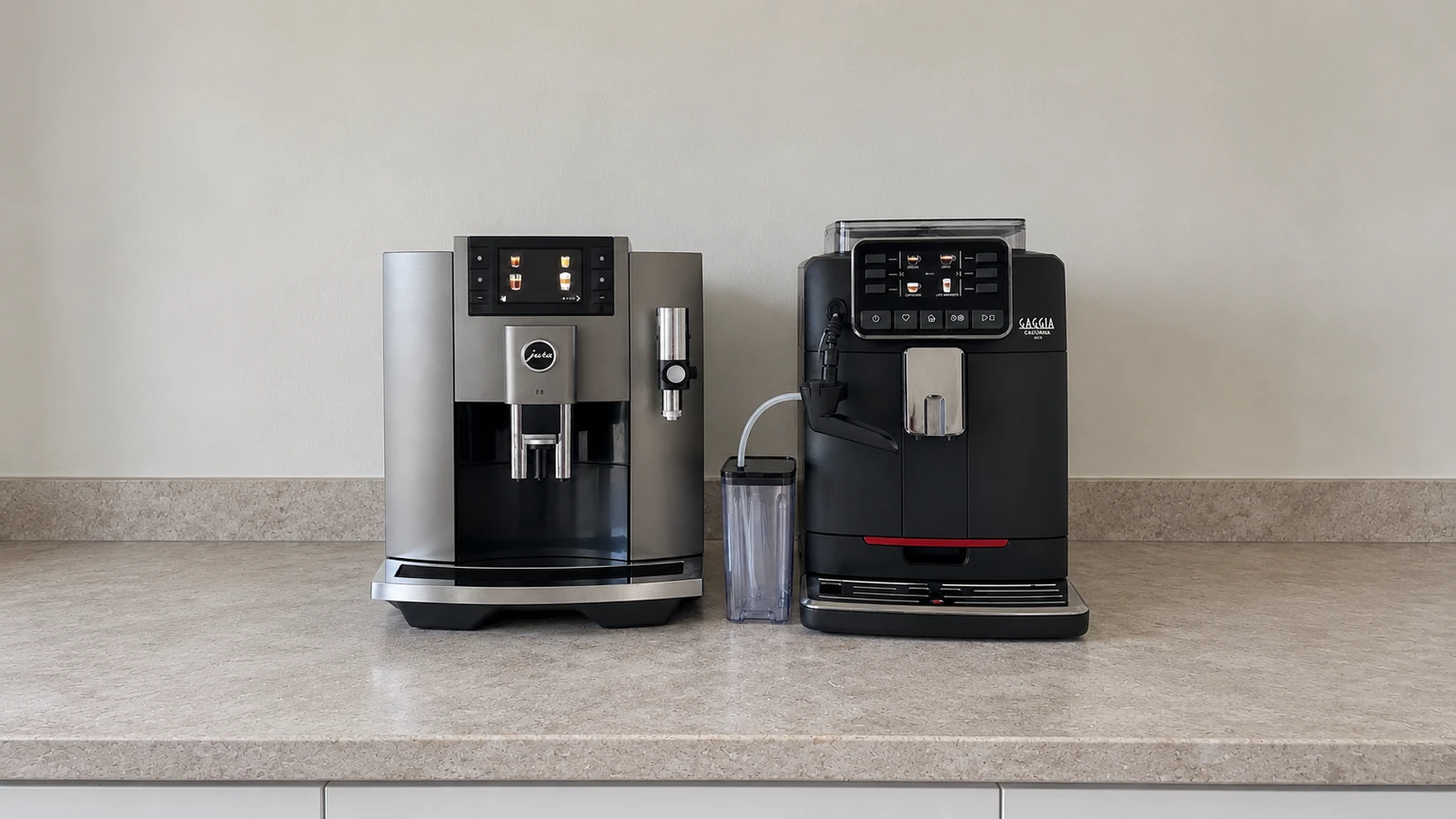
Quick answer: Jura makes better super-automatic espresso machines, but De'Longhi is much better value at the low end. Under about $1,000, get the De'Longhi Magnifica Evo. Above that, get a Jura: the Jura E6 for value, or the Jura E8 for the best all-round machine.
Both brands make a wide range of super-automatics, so I compare them in three price brackets, after looking at each brand's overall strengths.
Jura or De'Longhi?
Under about $1,000: De'Longhi. Specifically, the Magnifica Evo with its automatic milk frother.
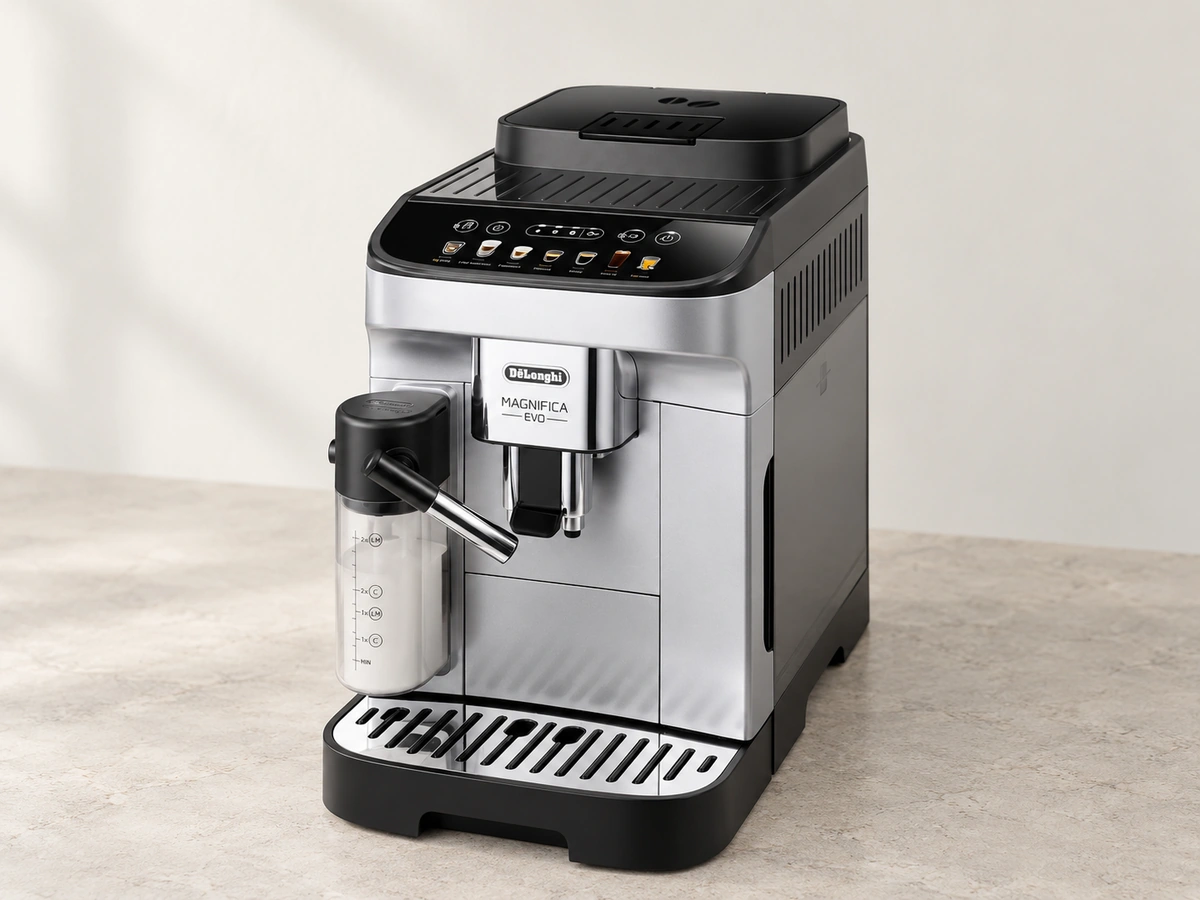
De'Longhi Magnifica Evo
Clear controls and one-touch milk drinks at a much lower price than any Jura.
Jura's cheapest machines have no milk system at all, which I think makes them poor value for most people.
Around $1,500: the Jura E6, one of the most affordable Juras that can froth milk.
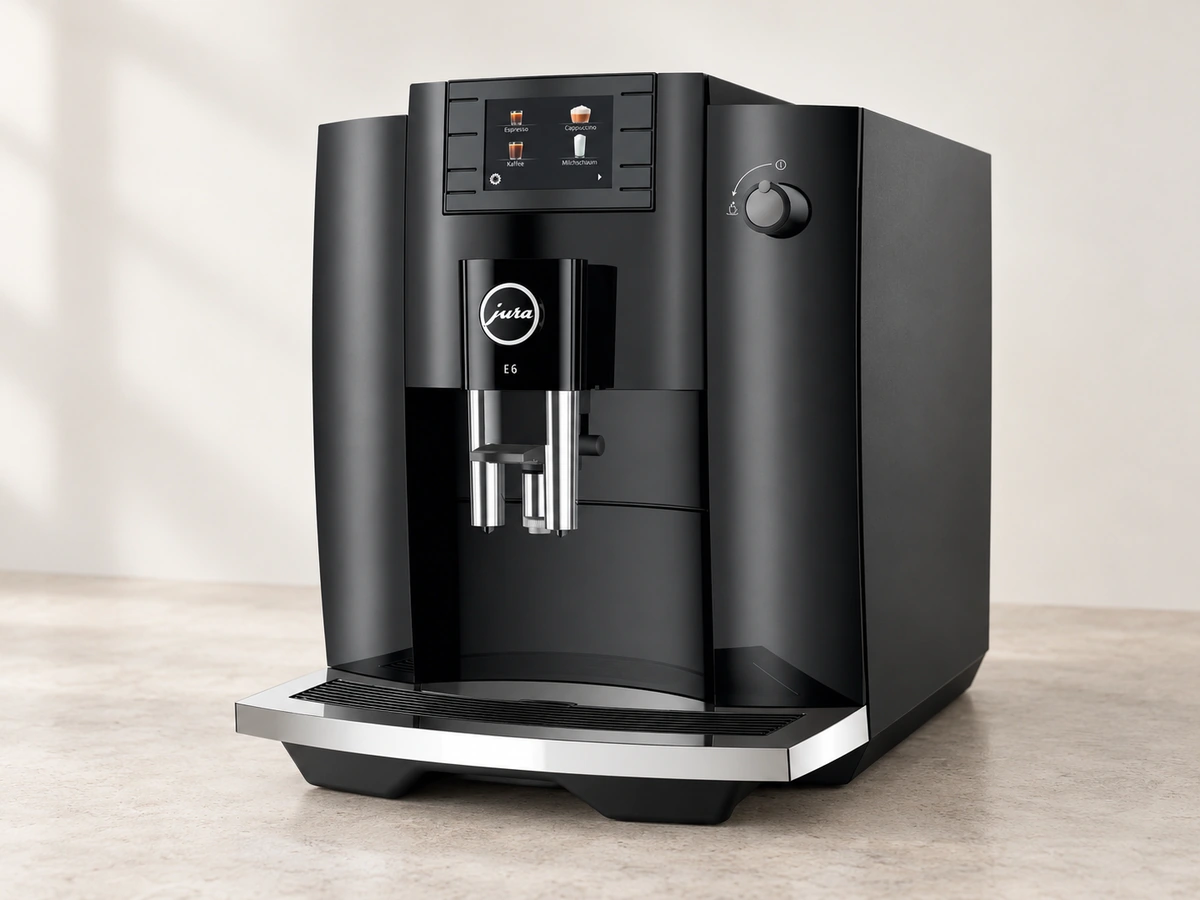
Jura E6
Jura espresso quality and one-touch milk drinks at Jura's entry price for milk.
Over about $1,500: the Jura E8. Read my Jura E8 review.
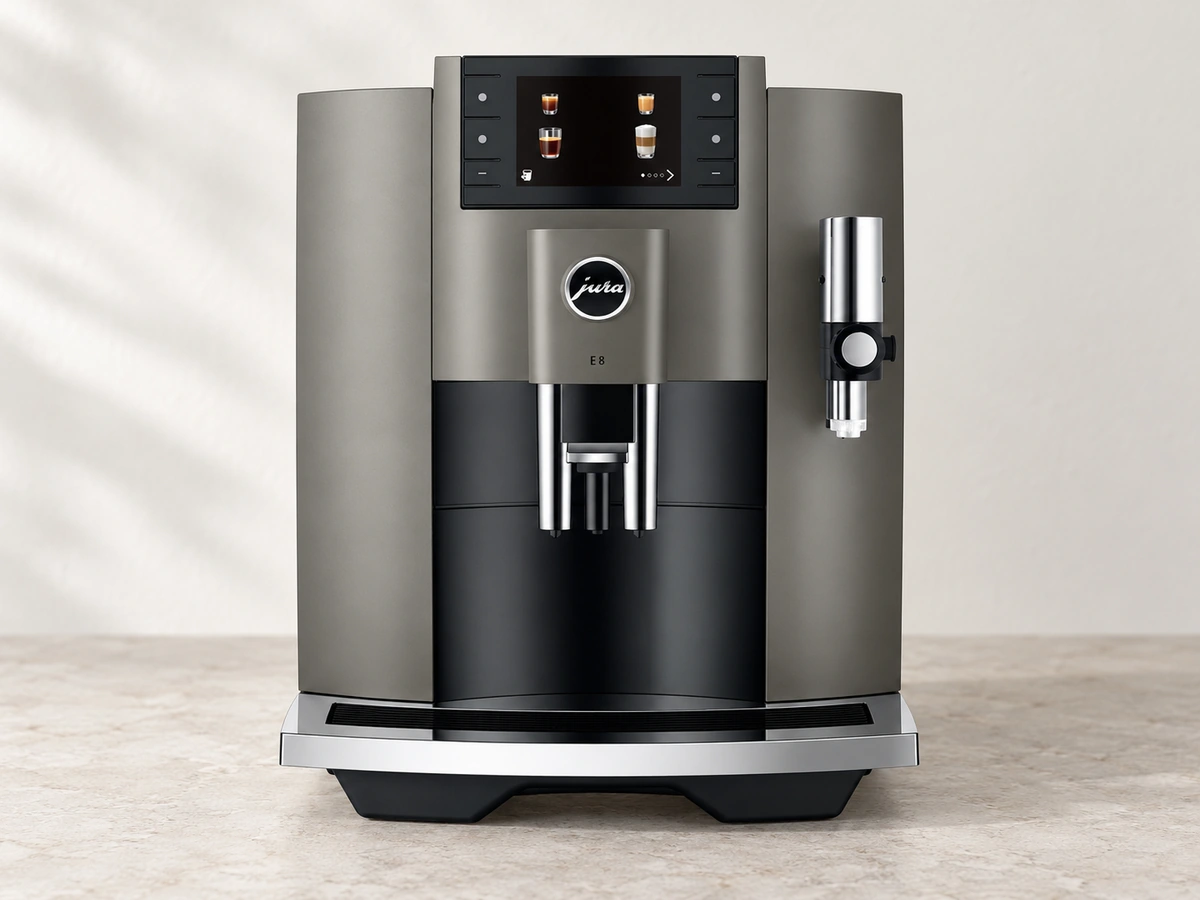
Jura E8
A big menu, great milk foam and easy controls.
How the Brands Differ
Jura only makes super-automatics. De'Longhi makes super-automatics and portafilter machines.
Jura generally makes better super-automatics: the drinks taste better, and the machines tend to last longer. But De'Longhi's range starts much cheaper, and a De'Longhi usually costs less than a Jura with similar features.
Coffee
Jura's espresso is better, but only slightly. Jura's pulse extraction process brews in short bursts for a more even, more complex shot. In James Hoffmann's comparison of bean-to-cup machines, Jura made the best espresso, but De'Longhi was not far behind.
Winner: Jura, just
Milk Foam
Jura's milk foam is clearly better, and the gap is bigger than for espresso. The milk foam is my favorite thing about my Jura E8. Its cappuccinos are close to café quality.
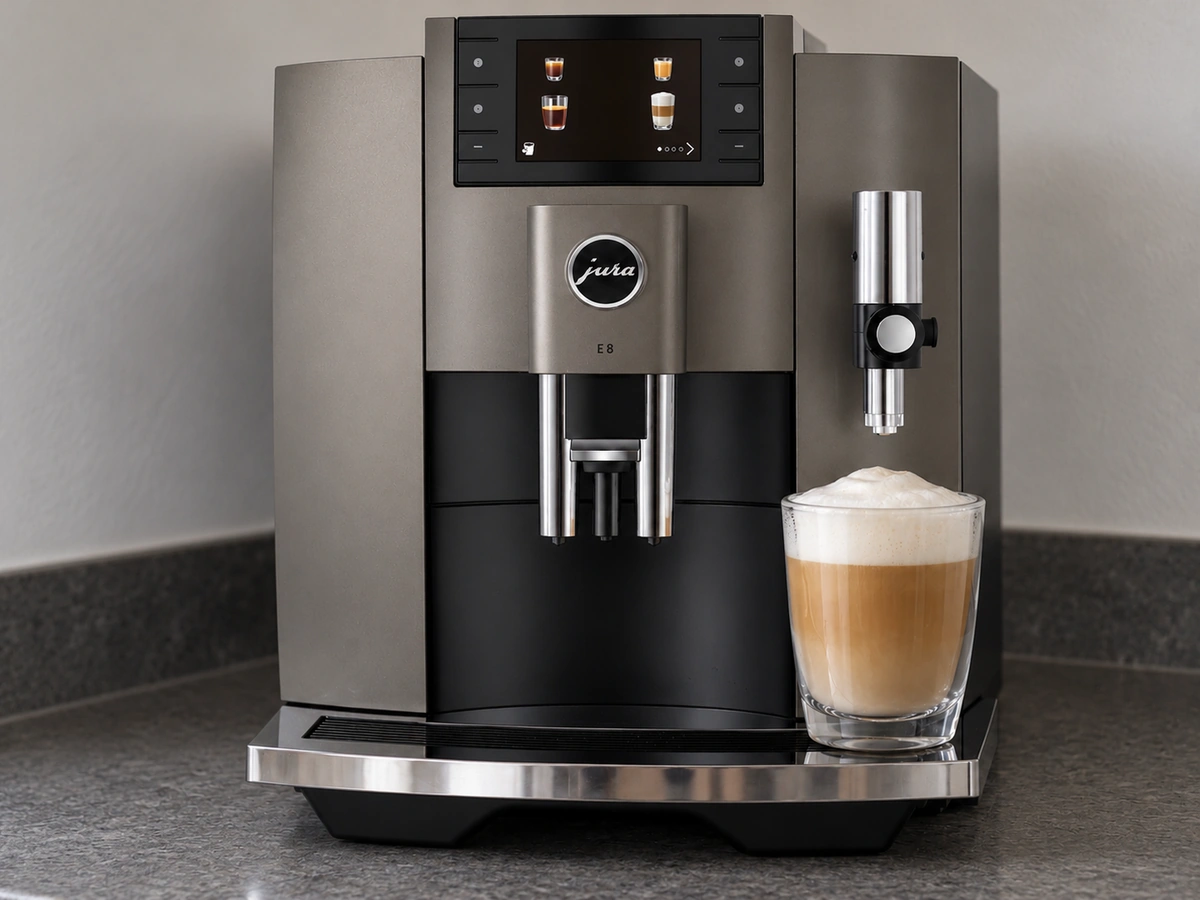
Hoffmann was disappointed by the De'Longhi Dinamica Plus's milk foam, saying the bubbles were too big. He agreed Jura's was much better, which matches my experience.
Winner: Jura
Features
De'Longhis offer more preset drinks for the money. Juras make customizing much easier.
In practice, both can make most of the same drinks. On a Jura, you sometimes get there by adjusting a preset, like making a flat white by brewing a cappuccino with less milk.
The big difference is at entry level. Jura's cheapest machines have no milk system, while De'Longhis at the same price include a frother or steam wand.
Winner: De'Longhi
Design and Build
Juras look more elegant and generally last longer. They feel more solid, with nicer and more responsive control panels. Many De'Longhi exteriors feel plasticky. Warranty terms vary by model and region for both brands.
Winner: Jura
Ease of Use and Cleaning
Juras are easier to use and keep clean.
Juras let you adjust strength and size while each drink is brewing. On a De'Longhi you usually program changes in advance, which is a hassle when several people with different tastes share the machine.
Both rinse their internal lines automatically, but Jura's milk system is easier to clean. It runs a milk system rinse after drinks, and you run a deeper clean with a cleaning tablet periodically. De'Longhi's LatteCrema carafe needs taking apart and washing by hand, though it is dishwasher safe.
On the other hand, De'Longhi's brew unit can be removed and rinsed at home, while Jura's needs professional servicing every few years.
Winner: Jura
Value
De'Longhi wins at the low end; Jura wins higher up. Jura's build quality means its premium machines should last longer, which pays for itself over time. I would rather pay 20% more for a machine that lasts much longer. But Jura does not really do budget machines, so on a tight budget De'Longhi is your only option.
Winner: De'Longhi for budget machines, Jura for pricier machines
Head to Head at Three Price Points
Entry Level: Jura A1 vs De'Longhi Magnifica Evo
I recommend the Magnifica Evo, because the Jura A1 cannot froth milk.
| Jura A1 | De'Longhi Magnifica Evo | |
|---|---|---|
| Black coffee drinks | Espresso, coffee | Espresso, coffee, double espresso, iced coffee |
| Milk drinks | None | Cappuccino, latte macchiato, My Latte |
| Milk system | None | Automatic frother |
| Water tank | ~37 oz | ~60 oz |
| Dimensions (W x D x H) | 12.7" x 20.5" x 18.6" (max) | 9.45" x 17.3" x 14.2" |
The A1 makes slightly better espresso, but I still recommend the De'Longhi for its versatility. Its controls show every drink with a clear picture and a single button, which is rare at this price, where many machines use cryptic dials and symbols.
It is also usually cheaper than the A1. Only consider the Jura A1 if you already have a way to froth milk and want the best possible espresso from a compact super-automatic. If you want black coffee from Jura, the ENA 4 is another option.
Read my Magnifica Evo review.
A Budget De'Longhi I Would Skip: Magnifica ESAM3300
The ESAM3300 is often recommended as a good cheap De'Longhi, so I want to share my own frustrating experience with it:
- It was so loud on startup that it bothered my housemates upstairs
- It kept asking me to empty the grounds container even when it was empty, and refused to brew
- A warning light kept coming on for no clear reason, and the machine would not brew until it went off. The manual did not explain it.
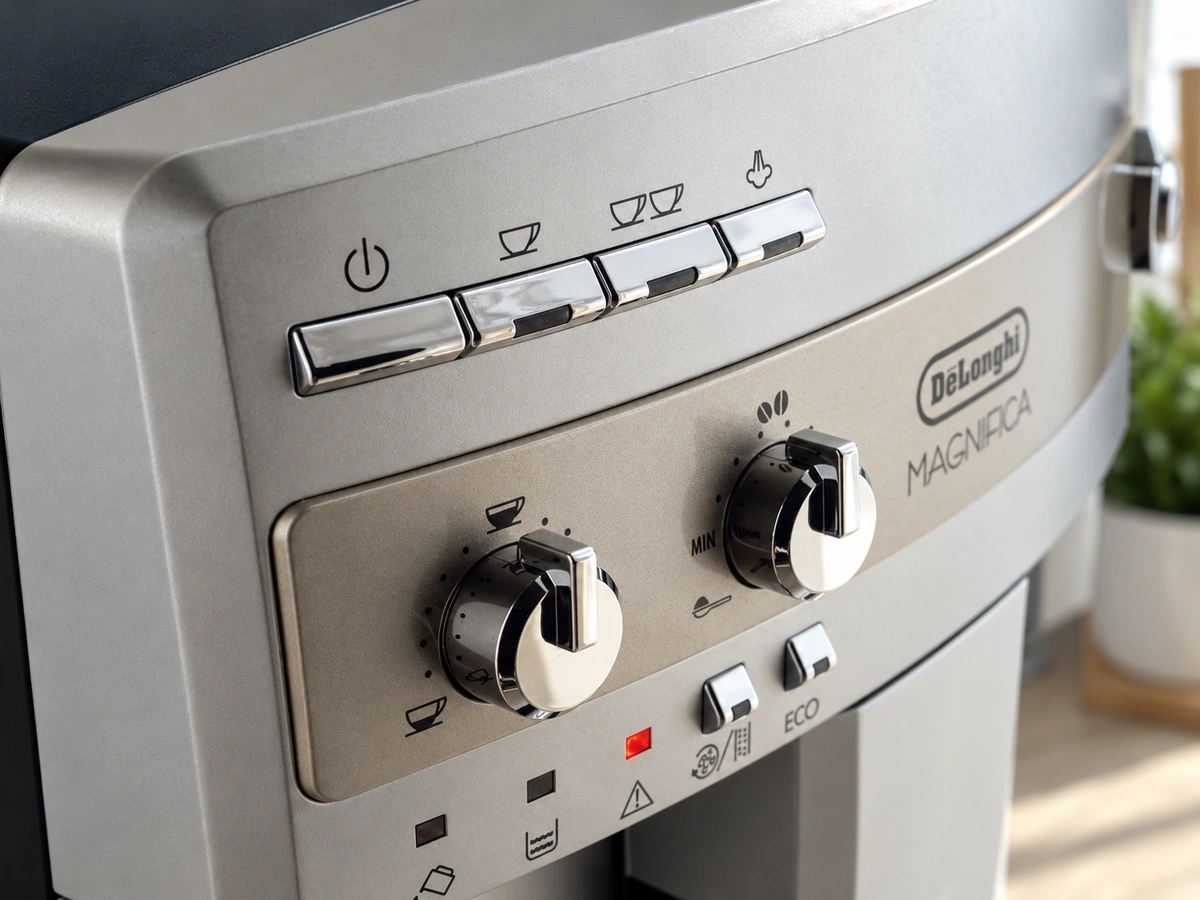
The espresso was decent, but the machine was so temperamental that I gave up after two weeks. Details in my Magnifica ESAM3300 review. Get the Magnifica Evo instead.
Mid-Range: Jura E6 vs De'Longhi Dinamica
I recommend the Jura E6, because its drinks taste better.
| Jura E6 | De'Longhi Dinamica | |
|---|---|---|
| Black coffee drinks | Espresso, coffee, Americano-style, doubles | Espresso, lungo, coffee, over ice |
| Milk drinks | Cappuccino, latte macchiato | Cappuccino, latte, flat white and more |
| Milk system | Automatic (separate container) | Automatic (carafe) or steam wand, depending on version |
| Water tank | ~64 oz | ~60 oz |
| Dimensions (W x D x H) | 11" x 17.6" x 13.8" | 9.3" x 16.9" x 13.7" |
The E6 has fewer milk presets, but you can make almost any milk drink by adjusting the milk:
- Flat white: brew a cappuccino with less milk
- Latte: brew a cappuccino with more milk
The E6 makes its drinks, especially cappuccinos, better than the Dinamica. The Dinamica is usually cheaper, though, so if budget is tight it is still a great machine. See my De'Longhi Dinamica review and Jura E6 review.
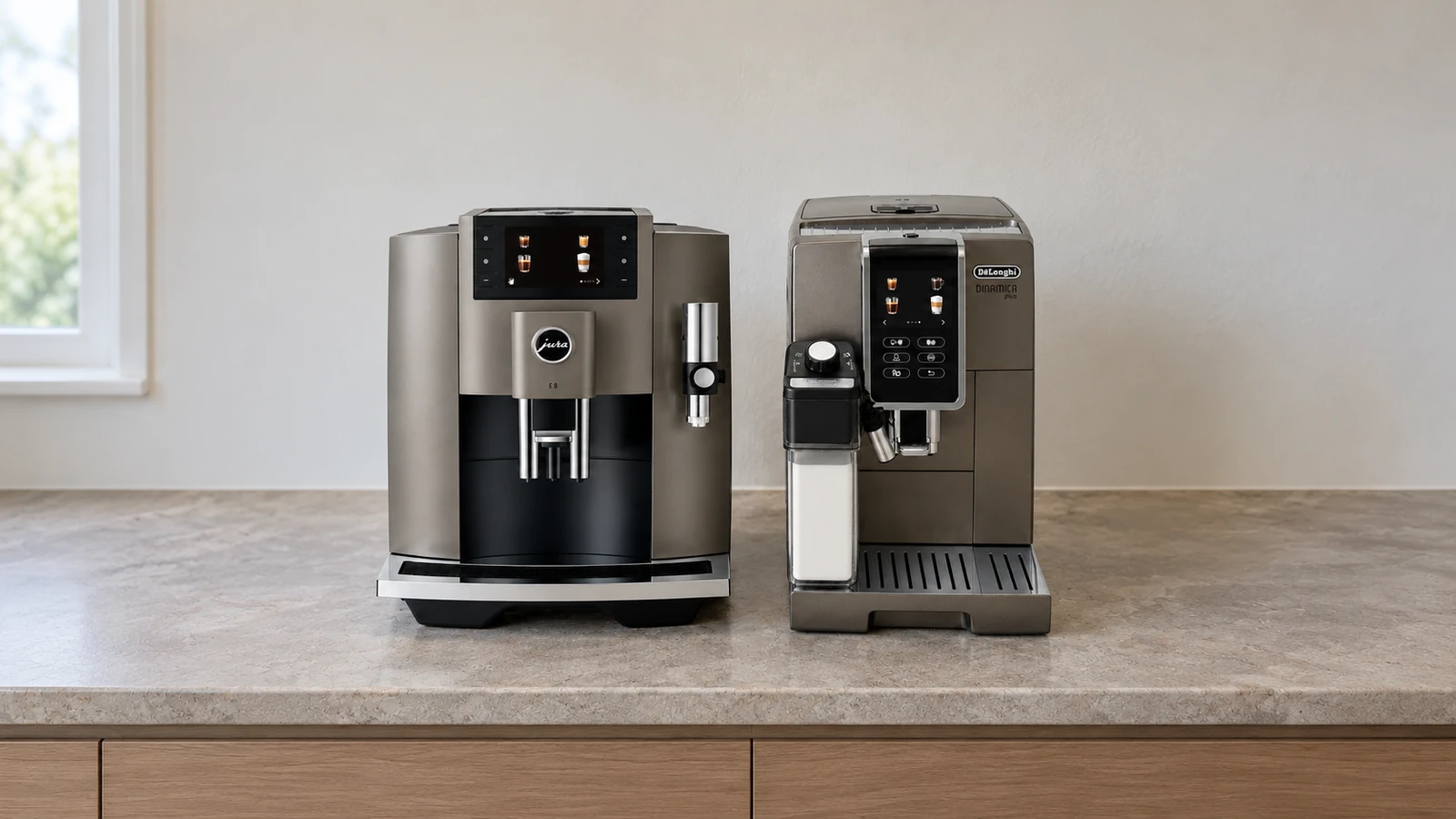
Premium: Jura E8 vs De'Longhi Dinamica Plus
I recommend the Jura E8. Again, it is about drink quality.
| Jura E8 | De'Longhi Dinamica Plus | |
|---|---|---|
| Black coffee drinks | Espresso, coffee, Americano-style, doubles | Espresso, coffee, pot of coffee, over ice and more |
| Milk drinks | Cappuccino, flat white, latte macchiato, macchiato and more | Latte, cappuccino, latte macchiato, flat white, cortado and more |
| Milk system | Automatic (separate container) | LatteCrema carafe |
| Water tank | ~64 oz | ~60 oz |
| Dimensions (W x D x H) | 11" x 17.6" x 13.8" | 9.3" x 17.3" x 14.2" |
De'Longhi adds "value" to its premium machines mainly by adding drinks, like pots of coffee and iced coffee. That does not do much for me, because super-automatics are not designed for those drinks.
Jura instead focuses on better controls and better espresso and milk. That is why Jura's lead grows as prices rise, and why I would choose the E8 over the Dinamica Plus. Read my Dinamica Plus review and Philips 5400 vs De'Longhi Dinamica Plus.
Jura or De'Longhi: My Pick
De'Longhi makes the better super-automatics under about $1,000. Above that, Jura's machines are better.
My pick of the bunch is the Jura E6. I think it offers the best value of either brand's machines with milk.
For more, see the best Jura coffee machines, the best De'Longhi espresso machines and the best super-automatic espresso machines.
Is Jura better than De'Longhi?
For coffee, milk foam and build quality, yes. De'Longhi is better value, especially under $1,000.
Why are Jura machines so expensive?
You pay for Jura's pulse extraction brewing, its excellent milk system, premium build and long lifespan.
Does Jura make a machine under $1,000?
Its cheapest machines are close to that price but have no milk system. For milk drinks under $1,000, De'Longhi or Philips is the better choice.
Written by · reviewed by the Cicada Coffee Bar team
Daniel Voss
Lead Equipment Reviewer, Cicada Coffee Bar
Daniel leads the equipment-testing side of Cicada Coffee Bar. Every super-automatic, semi-automatic, and grinder featured on this site is bought or sourced independently, set up on the test bench, and brewed with daily for at least two weeks before a single word is written — tracking espresso quality, milk texture, ease of cleaning, and long-term reliability. Reviews are updated whenever pricing or firmware changes.